



Beatrice Minns: Biography, Career, Art, and Personal Life
Beatrice Minns is a British artist and designer whose professional journey spans fine art, immersive theatre, illustration, animation, and contemporary ceramics. Although she is also known publicly as the wife of British actor and musician Johnny Flynn, her own creative career offers a compelling story of artistic versatility, craftsmanship, and a lasting interest in the relationship between objects, spaces, and human experience.
With professional credits connected to the renowned immersive theatre company Punchdrunk, Minns has contributed to productions that transform conventional theatrical storytelling into richly detailed environments. Her subsequent development as a ceramic artist reflects another dimension of her creative identity, bringing attention to handmade objects, natural materials, mythology, and personal memory.
Unlike many individuals connected to the entertainment industry, Minns maintains a relatively private public profile. Consequently, her professional accomplishments are more clearly documented than many details of her childhood, personal finances, or private family life. Understanding the distinction between verified information and online speculation is essential to presenting an accurate biography.
This article explores Beatrice Minns’s background, artistic education, theatre career, ceramics, relationship with Johnny Flynn, family life, and continuing creative identity.
Beatrice Minns Biography Table
| Category | Details |
|---|---|
| Full name | Beatrice Minns |
| Nationality | British |
| Profession | Artist, designer-maker, illustrator, animator, ceramic artist |
| Artistic training | Fine art, specialising in painting |
| Art institution | Winchester College of Art, as stated in a professional biography |
| Theatre association | Punchdrunk |
| Notable theatre credits | The Masque of the Red Death, The Drowned Man, The Burnt City |
| Current artistic practice | Handmade and thrown stoneware ceramics |
| Husband | Johnny Flynn |
| Marriage year | 2011 |
| Children | Three |
| Professional base | London, England |
| Creative interests | Ceramics, mythology, relics, nature, ceremony, meaningful objects |
| Public profile | Primarily focused on creative work, with personal life kept relatively private |
| Exact date of birth | Not reliably established in the principal professional biographies |
| Height | Not reliably confirmed |
| Net worth | Not publicly verified |
The information in this table reflects available professional biographies and Minns’s own description of her artistic practice. Personal details that cannot be established reliably have not been presented as confirmed facts.
Who Is Beatrice Minns?
Beatrice Minns is a multidisciplinary creative professional who has worked across several areas of visual art and design. Her background includes fine art, theatrical environments, illustration, animation, and the making of ceramic objects. This range distinguishes her from artists whose careers remain confined to a single medium.
Her professional biography from the American Repertory Theater identifies her as a fine artist trained in painting at Winchester College of Art. It also describes her work as a freelance designer-maker, illustrator, and animator based in London.
Theatre became an important part of her professional history, particularly through her association with Punchdrunk. The company is known for immersive productions in which audiences explore elaborately designed spaces rather than experiencing a performance exclusively from fixed seats.
In addition to theatre, Beatrice Minns has developed an independent ceramics practice. On her own professional website, she describes making hand-built and wheel-thrown stoneware in a garden studio in East London. Her stated interests include relics, mythology, ceremony, nature, and objects that preserve personal memories.
These different strands of her career demonstrate why her professional identity should not be reduced to her marriage. Her connection to Johnny Flynn has brought additional public attention, but her artistic work has its own history, methods, and creative direction.
Early Life and Artistic Influences
Publicly available information about Beatrice Minns’s early life is limited. Her professional records provide a clearer account of her artistic training and career than of her birthplace, childhood circumstances, parents, or other personal details. For this reason, a responsible biography should avoid assigning her an unverified birth date or inventing a detailed childhood narrative.
One important aspect of her early artistic development is her connection with ceramics. In an interview about her practice, Minns discussed attending pottery sessions at Camden Arts Centre during childhood. These early experiences introduced her to clay and established an interest that would later become an important part of her professional life.
The significance of this experience lies in the relationship between early experimentation and mature artistic practice. Working with clay requires patience, coordination, an understanding of material behaviour, and a willingness to learn through repeated attempts. Although childhood pottery classes do not by themselves explain an artist’s later achievements, they offer a documented starting point for understanding Minns’s long-standing interest in making physical objects.
Her subsequent education in fine art provided a broader foundation. Painting encourages artists to consider colour, composition, texture, perspective, and the emotional effects of visual arrangements. These concerns can also be relevant to theatrical design and ceramics, even though each discipline requires different practical skills.
Minns’s professional journey illustrates how an early interest can remain meaningful while changing form. Rather than following a single, predictable career path, she developed experience across several visual disciplines before returning more directly to the tactile possibilities of clay.
Education and Fine Art Training
Beatrice Minns received training as a fine artist, specialising in painting at Winchester College of Art, according to her biography published by the American Repertory Theater.
This detail is among the most useful pieces of information available about her professional foundation because it establishes a documented connection to formal artistic education. It also helps explain the breadth of her later work in design and image-making.
Fine art training typically involves developing an understanding of visual structure, materials, observation, and the communication of ideas through images. These abilities can prove valuable in theatre, where designers must create coherent environments that communicate a particular atmosphere or suggest an entire fictional world.
Painting and ceramics may initially appear to be separate practices. One primarily involves the application of pigments to a surface, while the other transforms a malleable material into a durable three-dimensional object. Yet both require decisions about form, surface, proportion, colour, and the viewer’s relationship with the finished work.
Similarly, theatrical design depends on spatial awareness and the ability to understand how individual elements contribute to a larger composition. Minns’s background across these disciplines suggests a creative practice shaped by visual thinking rather than by a narrow professional category.
The available professional record does not establish every detail of her qualifications or the exact dates of her education. It is therefore more accurate to describe her documented fine art training than to assign her an unverified degree title or academic timeline.
Beatrice Minns and Her Career in Theatre Design
Theatre design became a significant part of Beatrice Minns’s working life. Her official biography identifies several Punchdrunk productions among her credits and describes her broader freelance work in design-making, illustration, and animation.
Her work is particularly associated with immersive theatre, a form of performance that changes the conventional relationship between audience and stage. Instead of watching a production from a fixed position, visitors may move through a constructed environment, discover objects, encounter performers at close range, and piece together the narrative through their own experiences.
Such productions require careful coordination between artistic vision and practical execution. The design must support the story, establish the atmosphere, accommodate performers, and guide audience movement without necessarily making every narrative detail immediately obvious.
For designers, this creates a distinctive challenge. A room may need to look convincing from several angles, and objects that appear incidental can help establish a character’s history or suggest events that took place before the audience arrived. The environment itself becomes an important storytelling device.
Minns has publicly described working as a set designer for more than a decade before turning renewed attention to ceramics. This extended experience indicates that theatre design was not merely a brief professional experiment but a substantial phase of her career.
Her contribution should also be understood as collaborative. Large-scale theatre productions involve directors, designers, lighting specialists, sound professionals, costume departments, performers, and production teams. A designer’s work forms part of a coordinated creative undertaking, and individual responsibilities vary from one production to another.
Her Work With Punchdrunk
Punchdrunk is a British theatre company widely recognised for developing immersive performances in which carefully constructed environments play a central role. The company’s approach often combines theatrical performance with elaborate settings, movement through space, and unconventional forms of audience participation.
Beatrice Minns’s association with Punchdrunk is one of the best-documented aspects of her career. Her professional biography lists several productions, including Faust, The Masque of the Red Death, Tunnel 228, and It Felt Like a Kiss.
These projects demonstrate the range of environments and storytelling approaches with which she has been associated. The productions differ in their source material, scale, atmosphere, and creative context, but all belong to a theatre tradition in which design helps shape the audience’s experience.
The Masque of the Red Death
2007–2008
The Masque of the Red Death drew inspiration from the writing of Edgar Allan Poe and used the setting of Battersea Arts Centre to create a mysterious, unsettling theatrical world.
Punchdrunk’s production credits identify Beatrice Minns as a designer responsible for detail. This specific credit is important because it establishes a documented contribution without overstating her individual responsibility for the entire production.
In an immersive work influenced by gothic literature, visual detail can establish a sense of unease long before a character explains what is happening. Objects, rooms, textures, and architectural features can create connections between the fictional setting and its underlying themes.
The production demonstrates the kind of environment in which detailed design decisions can become integral to storytelling. It also provides an early example of Minns’s involvement in Punchdrunk’s distinctive theatrical approach.
Tunnel 228
Tunnel 228 is another production listed in Minns’s professional biography. Its inclusion reinforces the breadth of her association with the company rather than limiting her theatre work to a single celebrated title.
As with many immersive productions, projects of this kind depend on the relationship between the physical environment and the audience’s experience. Design must do more than provide an attractive background; it contributes to the atmosphere and the way visitors encounter the work.
Although the available biographical record does not establish every individual design decision Minns made for the production, the credit forms part of her documented professional history.
It Felt Like a Kiss
It Felt Like a Kiss brought together Punchdrunk, documentary filmmaker Adam Curtis, and musician Damon Albarn for the Manchester International Festival.
The project is notable for its combination of theatrical experience, documentary storytelling, and music. Its multidisciplinary character provides a useful example of the creative settings in which designers may work beyond conventional stage productions.
Minns’s association with the project illustrates the variety of artistic forms represented in her professional credits. It also reflects a wider characteristic of immersive theatre: its ability to combine different media into a single, carefully organised experience.
The Drowned Man: A Hollywood Fable
2013–2014
The Drowned Man: A Hollywood Fable was staged at Temple Studios in London and explored a fictional world shaped by the mythology and darker realities of the film industry.
Punchdrunk’s production credits list Beatrice Minns alongside Felix Barrett and Livi Vaughan as a designer. The production used a large, interconnected environment to create a setting where audiences could explore different spaces and encounter fragments of the story.
This approach places considerable importance on the relationship between architecture, objects, and narrative. A single room can suggest an entire fictional history through its furnishings and visual details, while movement between rooms can reveal contrasts between characters and locations.
Minns’s involvement in the production forms a significant part of her documented theatre career. It also illustrates the collaborative nature of immersive design, where numerous creative decisions must work together to create a coherent world.
The Burnt City
2022–2023
The Burnt City reimagined stories associated with the fall of Troy and drew on ancient Greek mythology. Presented by Punchdrunk in London, the production combined performance, movement, and a sprawling environment inspired by the worlds of Troy and Mycenae.
The official production credits identify Beatrice Minns, Felix Barrett, and Livi Vaughan as designers.
The mythological subject matter offered a setting in which architecture, symbolic objects, and the contrast between different spaces could support the storytelling. Rather than relying exclusively on spoken explanation, immersive theatre can allow audiences to interpret the world through what they see and encounter.
The production also connects with themes that appear in Minns’s independent ceramics practice, particularly her stated interest in mythology and objects with symbolic or ceremonial significance. This is a thematic connection rather than proof that her theatre work directly determined the form of her pottery.
Taken together, these credits establish Beatrice Minns as a contributor to several notable Punchdrunk productions across different periods. They offer a more substantial account of her career than a biography focused exclusively on celebrity relationships.
The Transition From Theatre to Ceramics
After working as a set designer for more than a decade, Beatrice Minns began giving greater attention to her childhood interest in clay. Her official website describes this renewed focus as a return to an early passion.
The shift from theatre design to ceramics represents a change in scale and working process. Immersive theatre typically requires the creation of large environments through collaboration with numerous specialists. Ceramics, by comparison, can involve sustained individual attention to a single object, from its initial form to its finished surface.
However, the two practices share important creative concerns. Both involve thinking in three dimensions, understanding how materials behave, and considering how an object occupies space. Both also allow an artist to communicate meaning through physical details rather than relying entirely on words.
For Minns, ceramics offers a way to make objects intended to be held, displayed, treasured, or incorporated into personal surroundings. Her stated interest in memories, relics, nature, and ceremony gives the practice a conceptual dimension beyond the production of functional household items.
This development does not necessarily mean that she has abandoned every other creative discipline. Her public work demonstrates a career that has moved between different forms of design and making, with ceramics becoming a particularly visible part of her independent artistic identity.
Beatrice Minns as a Ceramic Artist
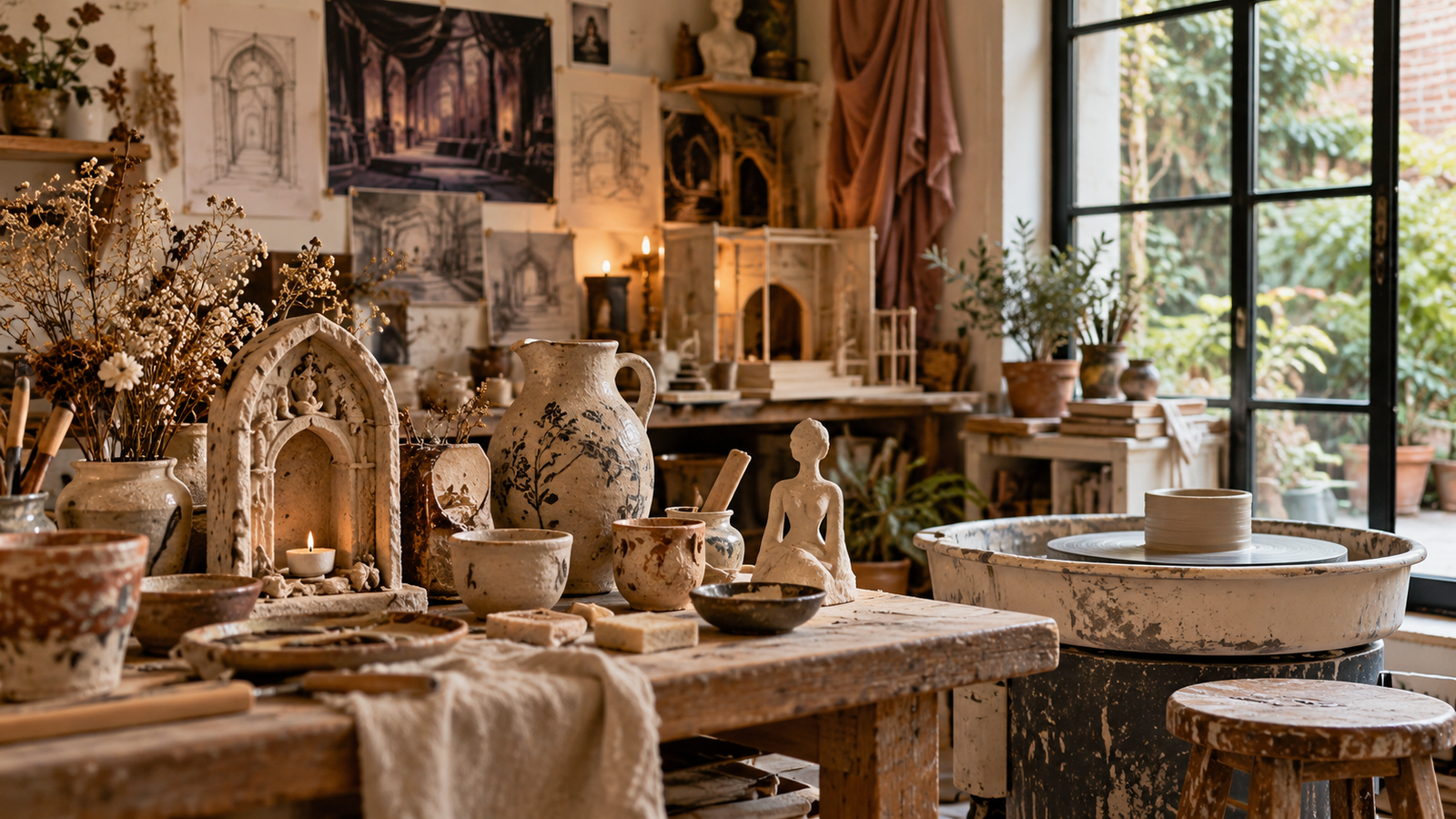
The ceramics practice of Beatrice Minns offers a more intimate perspective on her creative interests. Working from a garden studio at her home in East London, she makes hand-built and wheel-thrown stoneware pieces. Her own description places particular emphasis on the relationship between materials, memories, nature, and objects that hold personal significance.
Stoneware is a type of ceramic material fired at relatively high temperatures to produce a durable, often dense body. Depending on the clay, firing conditions, and surface treatment, stoneware can display a wide range of textures, colours, and finishes. It is suitable for functional vessels as well as sculptural work.
Minns’s practice encompasses two principal methods of forming clay. Hand-building allows the maker to shape a piece through direct manipulation, joining, and modelling. Wheel-throwing involves shaping clay on a rotating wheel, using controlled pressure to create forms such as bowls, pots, and vessels.
Each technique offers different possibilities. Hand-built objects can retain irregularities and visible evidence of the maker’s gestures, while wheel-thrown forms often develop a distinctive relationship between symmetry, proportion, and movement. Artists can also combine techniques to achieve more individual results.
For Beatrice Minns, these processes provide a means of exploring form and meaning through tangible materials. Her public description indicates that she is interested in making pieces that can preserve memories, celebrate precious objects, and draw attention to nature.
Rather than assuming that every piece has a specific hidden meaning, it is more useful to understand her work through the themes she has personally identified. This approach respects both the artist’s stated intentions and the possibility that viewers may develop their own interpretations.
Mythology, Relics, and the Meaning of Objects
One of the most distinctive aspects of Beatrice Minns’s artistic practice is her interest in relics, mythology, and ceremony. These subjects connect everyday physical objects with broader questions of history, belief, remembrance, and cultural meaning.
A relic can be understood as an object preserved because of its association with a person, event, tradition, or historical period. Its importance may arise from its material qualities, its history, or the significance assigned to it by those who preserve it.
Mythology offers another source of artistic inspiration. Myths often communicate ideas about human relationships, natural forces, mortality, transformation, and the relationship between individuals and their communities. Artists can draw on these themes without reproducing a particular story literally.
Ceremony, meanwhile, gives objects a role within repeated actions and shared experiences. A vessel, container, or carefully arranged object may become meaningful because of how it is used, where it is displayed, or the memories associated with it.
These interests help explain why Minns describes her ceramics in terms that extend beyond utility. A handmade vessel can serve a practical purpose while also becoming an object of personal attachment.
The connection between these themes and her theatre background is worth considering. Immersive theatre often uses physical spaces and carefully selected objects to suggest histories that audiences must interpret. Ceramics can create a similarly tangible relationship with meaning, although the scale and experience are different.
For readers interested in contemporary craft, this provides a useful way to understand the broader significance of her work. Her artistic identity brings together material experimentation and an interest in the stories that objects can carry.
Beatrice Minns and Johnny Flynn
Beatrice Minns is also widely known as the wife of Johnny Flynn, a British actor, musician, and songwriter. Flynn has developed a career across film, television, theatre, and music, earning recognition for his performances and songwriting.
The couple’s relationship predates much of Flynn’s later public success. In interviews, he has spoken about knowing Minns since their school years and about the importance of their long-standing relationship.
Their shared history is particularly interesting because both have pursued creative careers, albeit in different disciplines. Flynn’s public work centres on performance and music, while Minns’s documented career focuses on design, visual art, and ceramics.
The couple married in Wales in 2011, a detail Flynn confirmed in an interview published by The Guardian’s Observer archive in 2012. His account described an outdoor ceremony in the woods, reflecting a personal celebration rather than a conventional entertainment-industry event.
Although their professional lives sometimes intersect through the broader creative world, Minns has maintained an artistic identity of her own. Her theatre credits and ceramics practice can be understood independently of her husband’s acting and music career.
Their relationship is therefore an important part of her biography, but it is not the only aspect that deserves attention.
Family Life and Children
Beatrice Minns and Johnny Flynn have three children. Minns’s own website confirms that she lives with her husband and three children in East London.
Beyond these basic details, the family maintains a relatively private public profile. Information about their children’s personal lives is limited, and a professional biography does not need to turn that privacy into speculation.
Balancing creative work with family responsibilities can present practical challenges for people working in the arts. Theatre productions may involve demanding schedules and collaborative commitments, while ceramics requires time for preparing clay, forming pieces, managing drying and firing processes, and developing new work.
Flynn has spoken publicly about the demands of working while raising children, including the practical pressures the family experienced during the COVID-19 pandemic. Such comments provide some context for the family’s experience without establishing every detail of Minns’s personal routine.
Her professional description of working from a garden studio offers a clearer picture of her creative setting. It establishes that her ceramics practice is based at home, allowing her to work within a domestic environment rather than exclusively in a conventional commercial studio.
Nevertheless, the precise arrangements through which she balances work and family are private matters. The available information supports a description of her family circumstances, not assumptions about her daily schedule or personal priorities.
Artistic Identity Beyond Celebrity
Public interest in Beatrice Minns often begins with her connection to Johnny Flynn. However, treating her only as a celebrity spouse overlooks the documented range of her own creative work.
Her career includes formal fine art training, freelance design, illustration, animation, and involvement in immersive theatre. Her ceramics practice adds another dimension to this record, demonstrating an interest in making objects that combine practical form with personal or symbolic meaning.
This breadth is significant because contemporary creative careers do not always follow a straight line. Artists may move between disciplines, develop new skills, return to earlier interests, or change the scale at which they work.
Theatre design and ceramics offer contrasting forms of creative expression. One can involve complex, shared environments experienced by large audiences; the other can focus on individual objects that remain in people’s homes and personal spaces. Both require decisions about material, shape, atmosphere, and visual relationships.
Minns’s professional history brings these approaches together without requiring them to be treated as identical. Her theatre credits establish her experience in collaborative production, while her own website provides direct evidence of her independent work with clay.
A balanced understanding of Beatrice Minns therefore begins with her professional record. Her marriage explains part of the public interest in her life, but her work provides the clearest evidence of her individual achievements.
What Is Beatrice Minns Doing Now?
Beatrice Minns’s public ceramics website presents her work as an active part of her creative identity. It describes her ongoing interest in hand-built and thrown stoneware produced in her East London garden studio.
Her documented history also includes design credits for major Punchdrunk productions, including The Drowned Man and The Burnt City. These projects remain important reference points when assessing her contribution to immersive theatre.
It is worth distinguishing between a historical credit and a current appointment. A record of working on a particular production does not, by itself, establish that an artist remains employed by the same company or is participating in a new project.
Similarly, the presence of a ceramics website establishes how Minns presents her work publicly, but it does not independently verify every detail of her current schedule, production volume, or future plans.
The clearest picture is that her public creative identity encompasses both a substantial background in theatre design and a personal practice centred on ceramics. Any claims about new commissions, upcoming exhibitions, or particular future projects should be supported by current announcements rather than assumptions.
Beatrice Minns’s Net Worth and Earnings
There is no reliably established public figure for Beatrice Minns’s individual net worth. Although she has a documented professional history in theatre design and other creative disciplines, those records do not provide enough information to calculate her personal wealth.
Artists and designers may earn income through commissions, freelance contracts, production work, sales of handmade objects, and other creative activities. However, the existence of these potential income sources does not establish how much a particular individual earns.
Calculating net worth would require reliable information about assets, liabilities, income, business interests, and other financial circumstances. Such information is not comprehensively available for Minns through the professional biographies discussed here.
Her husband’s earnings should not be substituted for her own finances, and online estimates without transparent supporting evidence should be treated cautiously.
For readers seeking a factual biography, the distinction matters: a person’s occupation and professional accomplishments can be documented even when their private financial position cannot.
Lesser-Known Facts About Beatrice Minns
Several details help provide a more rounded picture of Beatrice Minns beyond her public association with Johnny Flynn.
- She has worked across several creative disciplines, including fine art, theatre design, illustration, and animation.
- Her professional biography identifies painting as her area of specialisation during her fine art training.
- Her childhood included pottery sessions at Camden Arts Centre, according to an interview about her ceramics practice.
- She has described returning to clay after spending more than a decade working as a set designer.
- Her ceramics include hand-built and wheel-thrown stoneware.
- Her stated artistic interests include mythology, relics, ceremony, nature, and meaningful objects.
- Her theatre credits include productions associated with Punchdrunk, a company recognised for immersive performance.
- She and Johnny Flynn married in Wales in 2011 and have three children.
These details are supported by professional biographies, Minns’s own public description of her practice, production credits, and Flynn’s interviews. They provide a more dependable account of her life than unsupported claims about her private finances or personal characteristics.
Frequently Asked Questions About Beatrice Minns
1. Who is Beatrice Minns?
Beatrice Minns is a British artist and designer known for her work in fine art, immersive theatre, illustration, animation, and ceramics. She is also publicly known as the wife of actor and musician Johnny Flynn.
2. What is Beatrice Minns famous for?
She is known for her design work with Punchdrunk, including productions such as The Masque of the Red Death, The Drowned Man: A Hollywood Fable, and The Burnt City. Her independent ceramics practice is another important part of her professional identity.
3. Is Beatrice Minns an artist?
Yes. Her professional biography identifies her as a trained fine artist, designer-maker, illustrator, and animator. She also makes handmade and wheel-thrown stoneware ceramics.
4. Who is Beatrice Minns’s husband?
Her husband is Johnny Flynn, a British actor, musician, and songwriter. The couple married in Wales in 2011.
5. How many children do Beatrice Minns and Johnny Flynn have?
They have three children. Both Minns’s public website and interviews with Flynn support this information.
6. Where does Beatrice Minns live?
Her official artistic website identifies East London as her home and working base. She describes producing ceramics in a garden studio there.
7. What kind of ceramics does Beatrice Minns make?
She makes hand-built and wheel-thrown stoneware. Her stated interests include mythology, relics, ceremony, nature, and objects associated with memory and personal significance.
8. What did Beatrice Minns study?
Her professional biography states that she trained as a fine artist, specialising in painting at Winchester College of Art. The available record does not establish every detail of her academic qualifications.
9. How old is Beatrice Minns?
Her exact date of birth and age are not reliably established by the principal professional biographies used for this article. An exact age should not be stated as fact without a trustworthy source confirming it.
10. What is Beatrice Minns’s net worth?
Her individual net worth has not been reliably established in public sources. Estimates published without verifiable financial information should be treated as speculative.
11. Did Beatrice Minns work with Punchdrunk?
Yes. Her professional biography and production credits associate her with several Punchdrunk projects, including The Masque of the Red Death, The Drowned Man, and The Burnt City.
12. Is Beatrice Minns still a theatre designer?
Her documented career includes more than a decade of set design work, while her public website currently presents her ceramics practice. Without a confirmed announcement about her latest employment or commissions, it is more accurate to describe both aspects of her professional history than to assume that she has permanently left theatre design.
The Lasting Significance of Her Creative Journey
Beatrice Minns’s professional story offers an example of how an artist can develop across different media while retaining an interest in the physical and visual qualities of the world. Her experience in immersive theatre demonstrates an ability to contribute to complex, collaborative environments, while her ceramics practice brings attention to the scale and intimacy of individual handmade objects.
Her career is also a reminder that public recognition does not always provide a complete picture of a person’s accomplishments. Although her marriage to Johnny Flynn has attracted attention, her documented artistic training, design credits, and work with stoneware offer a more substantial understanding of her creative identity.
For readers discovering Beatrice Minns for the first time, the most valuable details are not unverified claims about her wealth or private life. They are the established facts of her professional journey: her training in fine art, her contribution to immersive theatre, her renewed interest in clay, and her continuing exploration of objects, memory, mythology, and nature.
That combination of practical craftsmanship and conceptual curiosity makes her an interesting figure within contemporary British creative practice