



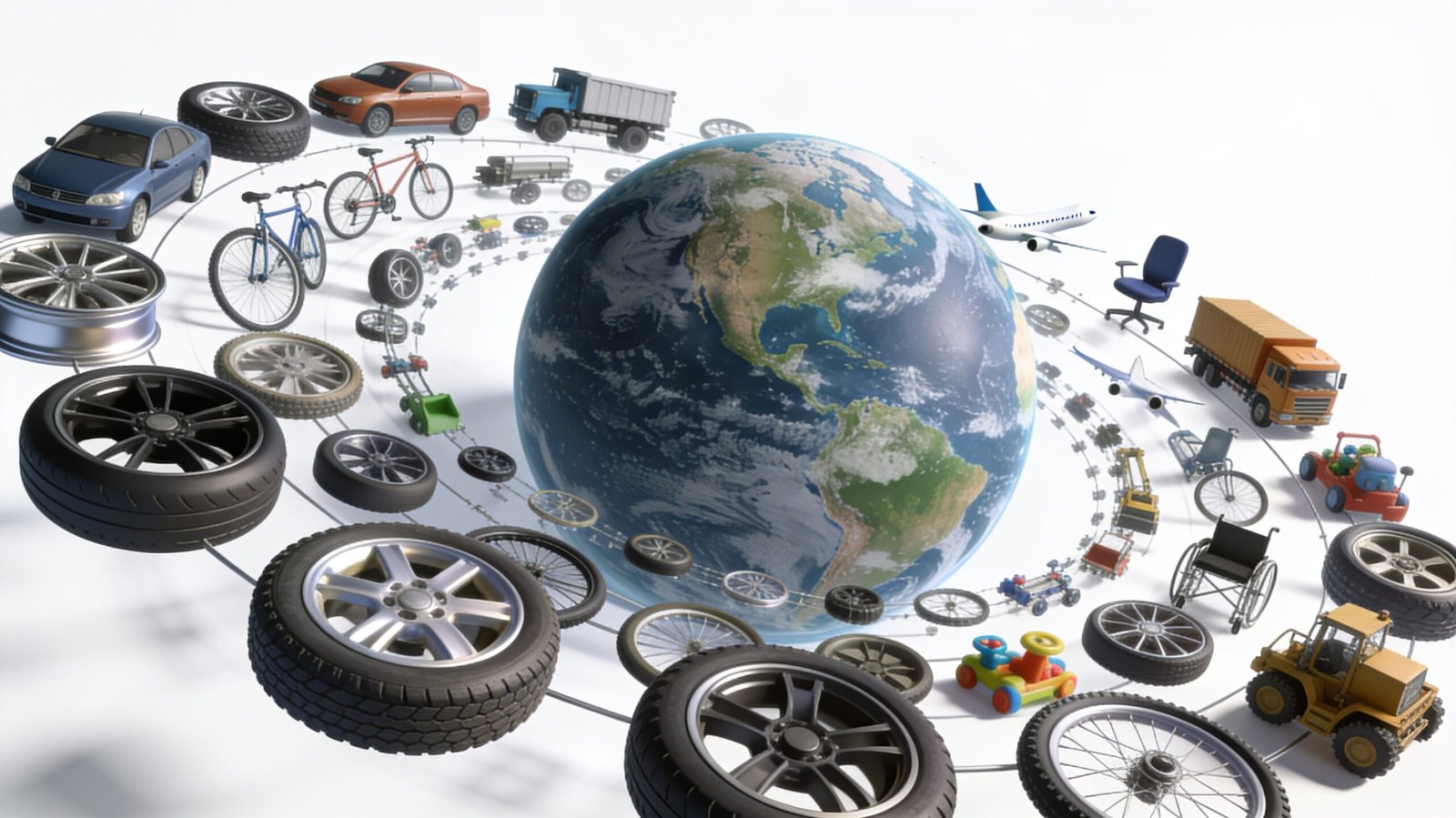
How Many Wheels Are in the World? A Deep Exploration of a Surprisingly Complex Question
At first glance, the question how many wheels are in the world seems simple. Most people imagine counting wheels on cars, bicycles, and trucks, then arriving at a rough number. Yet once the topic is examined closely, it becomes one of the most fascinating counting challenges imaginable.
Wheels are everywhere. They power transportation, manufacturing, logistics, healthcare, entertainment, and household convenience. From gigantic mining trucks to tiny toy cars, wheels are so deeply integrated into modern civilization that imagining a world without them feels almost impossible.
Asking how many wheels are in the world requires more than counting vehicles. It means considering every wheel used by humans across industries and daily life. That includes obvious categories such as cars and motorcycles, but also less obvious ones like office chairs, shopping carts, hospital beds, luggage, factory equipment, robotics, and children’s toys.
The challenge becomes even greater when accounting for production rates. Every year, hundreds of millions of new wheels are manufactured while old wheels are discarded. Because of this constant turnover, any estimate is dynamic rather than fixed.
This article explores the question in detail, using logical estimation methods and category-based analysis to understand how many wheels are in the world.
Why Counting Wheels Is More Difficult Than It Sounds
The primary difficulty in answering how many wheels are in the world lies in defining what counts as a wheel.
Should only transportation wheels be counted? Or should caster wheels on chairs count as well? What about gears and pulleys? Are toy wheels equal to industrial wheels?
Most practical estimates define a wheel as a circular component designed to rotate around an axle to facilitate movement or mechanical function.
Under that definition, all of these count:
- Car wheels
- Bicycle wheels
- Truck wheels
- Wheelchairs
- Office chair casters
- Toy wheels
- Shopping cart wheels
- Suitcase wheels
- Industrial machinery wheels
Once these categories are included, the total increases dramatically.
Quick Statistics Table
The following table provides a high-level overview of estimated wheel counts by category.
| Category | Estimated Units | Wheels per Unit | Estimated Total Wheels |
|---|---|---|---|
| Passenger Cars | 1.6 billion | 4 | 6.4 billion |
| Motorcycles | 700 million | 2 | 1.4 billion |
| Bicycles | 2 billion | 2 | 4 billion |
| Trucks & Buses | 400 million | 6 average | 2.4 billion |
| Airplanes | 40,000+ | 6–22+ | 1 million+ |
| Office Chairs | 1 billion | 5 | 5 billion |
| Shopping Carts | 200 million | 4 | 800 million |
| Suitcases | 1.5 billion | 2–4 | 4.5 billion |
| Toys | 10+ billion | 2–8 | 40+ billion |
| Industrial Equipment | Massive | Varies | 20+ billion |
This table already suggests something surprising: toys and small household objects may contain more wheels than vehicles.
Wheels in Passenger Cars
Passenger cars are the most obvious category when discussing how many wheels are in the world.
Global vehicle estimates suggest there are approximately 1.5 to 1.7 billion passenger cars in operation.
Each standard car has:
- 4 primary wheels
- Often 1 spare wheel
- Sometimes additional steering mechanisms involving wheel-like components
Using only primary wheels:
1.6 billion × 4 = 6.4 billion wheels
If spare tires are included, the number rises significantly.
Cars alone contribute billions of wheels to the global total.
Trucks, Heavy Vehicles, and Commercial Transport
Commercial transportation adds a massive number of wheels.
Examples include:
- Delivery trucks
- Semi-trailers
- Construction vehicles
- Mining dump trucks
- Agricultural machinery
- Public buses
Heavy trucks often have:
- 6 wheels
- 10 wheels
- 18 wheels
- More in specialized equipment
Even conservative estimates produce enormous numbers.
Suppose 400 million heavy vehicles exist worldwide with an average of 6 wheels.
That equals:
400 million × 6 = 2.4 billion wheels
This category alone rivals bicycle totals in some estimates.
Bicycle Wheels Worldwide
Bicycles are among humanity’s most common wheeled inventions.
Experts estimate more than 2 billion bicycles exist globally.
In some regions, bicycles outnumber cars significantly due to affordability and practicality.
Each bicycle usually has:
- 2 main wheels
- Occasionally training wheels
Standard calculation:
2 billion × 2 = 4 billion wheels
When discussing how many wheels are in the world, bicycles become a major contributor.
Motorcycles and Scooters
Motorcycles dominate transportation in many countries across Asia, Africa, and Latin America.
Estimates suggest approximately 700 million motorcycles and scooters are actively used.
Each typically has:
- 2 wheels
Total:
700 million × 2 = 1.4 billion wheels
Scooters and motorcycles therefore represent another major category in determining how many wheels are in the world.
Airplanes and Aviation
Many people overlook aviation when estimating wheel totals.
Commercial aircraft use surprisingly large numbers of wheels.
Examples:
- Small aircraft: 3 wheels
- Narrow-body jets: 6 wheels
- Wide-body jets: 12–22 wheels
- Cargo aircraft: 20+ wheels
Large aircraft like the Boeing 747 can have 18 wheels.
Although total aircraft numbers are relatively small compared to cars, aviation still contributes millions of wheels globally.
Trains and Rail Transport
Rail transport uses wheels in astonishing numbers.
Each rail car can contain multiple wheelsets.
Examples:
- Passenger car: 8 wheels
- Freight wagon: 8 wheels
- Locomotive: 12+ wheels
Freight rail systems worldwide operate millions of railcars.
Because trains are heavy and industrial-scale, rail wheels are among the strongest engineered wheels on Earth.
Office Chairs: The Hidden Wheel Giant
One of the most surprising contributors to how many wheels are in the world is the office chair.
Modern office chairs typically have:
- 5 caster wheels
Consider global office usage:
If 1 billion office chairs exist:
1 billion × 5 = 5 billion wheels
That number alone nearly matches global car wheel totals.
This explains why office furniture often enters debates about wheel counts.
Shopping Carts and Retail Equipment
Retail stores rely heavily on wheeled equipment.
Common examples include:
- Shopping carts
- Warehouse carts
- Stock trolleys
- Pallet movers
A standard shopping cart contains:
- 4 wheels
If 200 million shopping carts exist worldwide:
200 million × 4 = 800 million wheels
That is already a significant contribution.
Luggage and Suitcases
Modern travel transformed luggage design.
Older luggage often used:
- 2 wheels
Modern spinner luggage usually uses:
- 4 wheels
Suppose 1.5 billion wheeled suitcases exist worldwide with an average of 3 wheels.
That produces:
4.5 billion wheels
This category is often ignored when estimating how many wheels are in the world.
Hospital Equipment and Medical Devices
Healthcare systems depend on wheeled mobility.
Examples include:
- Hospital beds
- Stretchers
- Wheelchairs
- Equipment stands
- Mobile monitors
Hospital beds often have 4 wheels.
Wheelchairs typically use:
- 4 wheels (2 large + 2 caster)
Globally, medical wheel counts reach into the hundreds of millions.
Industrial Machinery
Factories and warehouses contain countless wheeled systems.
These include:
- Conveyor rollers
- Production carts
- Robotic platforms
- Mobile tool systems
- Material handling devices
Industrial wheel totals are difficult to estimate because many are embedded inside machinery and never seen by consumers.
Still, this category likely contributes tens of billions of wheels worldwide.
That makes industrial usage crucial in understanding how many wheels are in the world.
Toy Wheels: The Massive Surprise
Toy wheels may be the single largest category.
Examples include:
- Toy cars
- Mini trucks
- LEGO vehicles
- RC cars
- Baby strollers
- Ride-on toys
Children’s toys are manufactured in staggering quantities.
If 10 billion wheeled toys exist worldwide and each averages 4 wheels:
10 billion × 4 = 40 billion wheels
This instantly changes the debate.
Toys alone may exceed all transportation wheels combined.
When discussing how many wheels are in the world, toy manufacturing cannot be ignored.
Baby Equipment
Parents frequently use wheeled products.
Examples:
- Strollers
- Prams
- Walkers
- Baby ride-ons
Most strollers use:
- 4 wheels
Given global birth rates, baby equipment contributes billions more wheels over time.
Household Wheels You Probably Forgot
Many homes contain dozens of wheels.
Examples include:
- Rolling drawers
- Vacuum cleaners
- Wheelbarrows
- Portable AC units
- Toolboxes
- Rolling beds
- Laundry baskets
A typical household may contain far more wheels than expected.
Multiply that by billions of households worldwide, and the total becomes enormous.
Historical Wheel Production
To understand how many wheels are in the world, historical manufacturing matters.
The wheel was invented thousands of years ago, around 3500 BCE.
Over millennia, wheel technology evolved:
- Wooden wheels
- Iron-rimmed wheels
- Rubber tires
- Pneumatic wheels
- Alloy wheels
- Carbon fiber wheels
Industrialization accelerated wheel production dramatically.
The 20th century especially saw explosive growth due to automobiles and consumer products.
Annual Wheel Manufacturing
The world manufactures vast numbers of new wheels every year.
Major industries include:
- Automotive manufacturing
- Bicycle production
- Tire manufacturing
- Industrial equipment
- Toy production
Vehicle tire production alone exceeds billions annually.
When adding all other wheel types, annual global wheel production likely reaches tens of billions.
This constant production makes the answer to how many wheels are in the world continuously change.
The Famous Wheels vs Doors Debate
A viral internet debate asked:
Are there more wheels or doors in the world?
This question sparked global discussion.
Supporters of “doors” pointed to:
- Houses
- Apartments
- Cabinets
- Vehicles
Supporters of “wheels” pointed to:
- Toys
- Chairs
- Industry
- Small wheeled objects
The biggest revelation came from overlooked wheel-heavy categories like office chairs and toys.
These categories strongly support the argument that wheels outnumber doors.
Estimating the Global Total
Now let us combine major categories.
Approximate totals:
- Cars: 6.4 billion
- Trucks/Buses: 2.4 billion
- Bicycles: 4 billion
- Motorcycles: 1.4 billion
- Office chairs: 5 billion
- Suitcases: 4.5 billion
- Shopping carts: 0.8 billion
- Toys: 40 billion
- Industrial equipment: 20+ billion
- Household miscellaneous: 10+ billion
Subtotal:
~94+ billion wheels
This is conservative.
Some broader estimates exceed:
100 billion wheels
Others suggest totals well beyond:
150 billion wheels
Thus, the most reasonable answer to how many wheels are in the world is likely:
Between 100 billion and 150 billion wheels
Why Exact Counting Is Impossible
An exact number remains impossible for several reasons.
Continuous Production
Factories produce new wheels daily.
Disposal
Old wheels are recycled or discarded constantly.
Untracked Products
Small consumer goods often go undocumented.
Hidden Wheels
Many machines contain internal wheels or rollers.
Because of these variables, any answer to how many wheels are in the world must remain an estimate.
A World Built on Rotation
The wheel is more than a circular object.
It represents one of humanity’s most transformative inventions.
Without wheels, modern civilization would struggle to function.
Wheels enable:
- Trade
- Travel
- Logistics
- Emergency response
- Manufacturing
- Daily convenience
Nearly every supply chain on Earth depends on rotational motion.
From groceries reaching supermarkets to airplanes transporting cargo, wheels quietly support global infrastructure.
That reality makes the question how many wheels are in the world more meaningful than it first appears.
Key Facts Table (Biography-Style Overview)
Since a quick-reference table is useful, here is a biography-style summary of the topic.
| Topic | Details |
|---|---|
| Subject | Global wheel count |
| Estimated Total Wheels | 100–150+ billion |
| Largest Category | Toys |
| Major Contributors | Cars, bicycles, office chairs, industry |
| Oldest Wheel | ~3500 BCE |
| Fastest Growing Category | Consumer products and logistics |
| Counting Difficulty | Extremely high |
| Exact Number Known? | No |
| Best Estimate Method | Category-based statistical modeling |
FAQs
How many wheels are in the world exactly?
No exact count exists. Because wheels are constantly manufactured and discarded, only estimates are possible. Most reasonable estimates place the total above 100 billion.
Are there more wheels or doors in the world?
Most large-scale estimates suggest wheels likely outnumber doors, largely because of toys, office chairs, and industrial equipment.
How many car wheels are in the world?
With approximately 1.6 billion passenger cars globally, there are roughly 6.4 billion car wheels excluding spare tires.
Do toy wheels really matter in wheel counts?
Yes. Toy wheels may be the largest single category, potentially contributing over 40 billion wheels.
Why is it hard to calculate how many wheels are in the world?
The difficulty comes from hidden industrial wheels, household items, continuous manufacturing, and inconsistent global data.
What invention made wheels important?
The original wheel transformed transportation, agriculture, trade, and engineering, becoming one of humanity’s most influential inventions.
Beyond the Numbers: The Endless Motion of Civilization
The question how many wheels are in the world ultimately reveals something profound about human progress. Wheels are embedded in nearly every layer of society—from the smallest toy in a child’s room to the largest industrial machine moving tons of cargo. Their presence reflects movement, innovation, and efficiency. Whether the true number is 100 billion or far higher, one thing is certain: the modern world runs on wheels, and their silent rotation continues to shape civilization every second.