



Ark Encounter: The Definitive Guide to the Full-Scale Noah’s Ark
Monumental Timber and Modern Apologetics: The Architectural and Cultural Phenomenon of the Ark Encounter
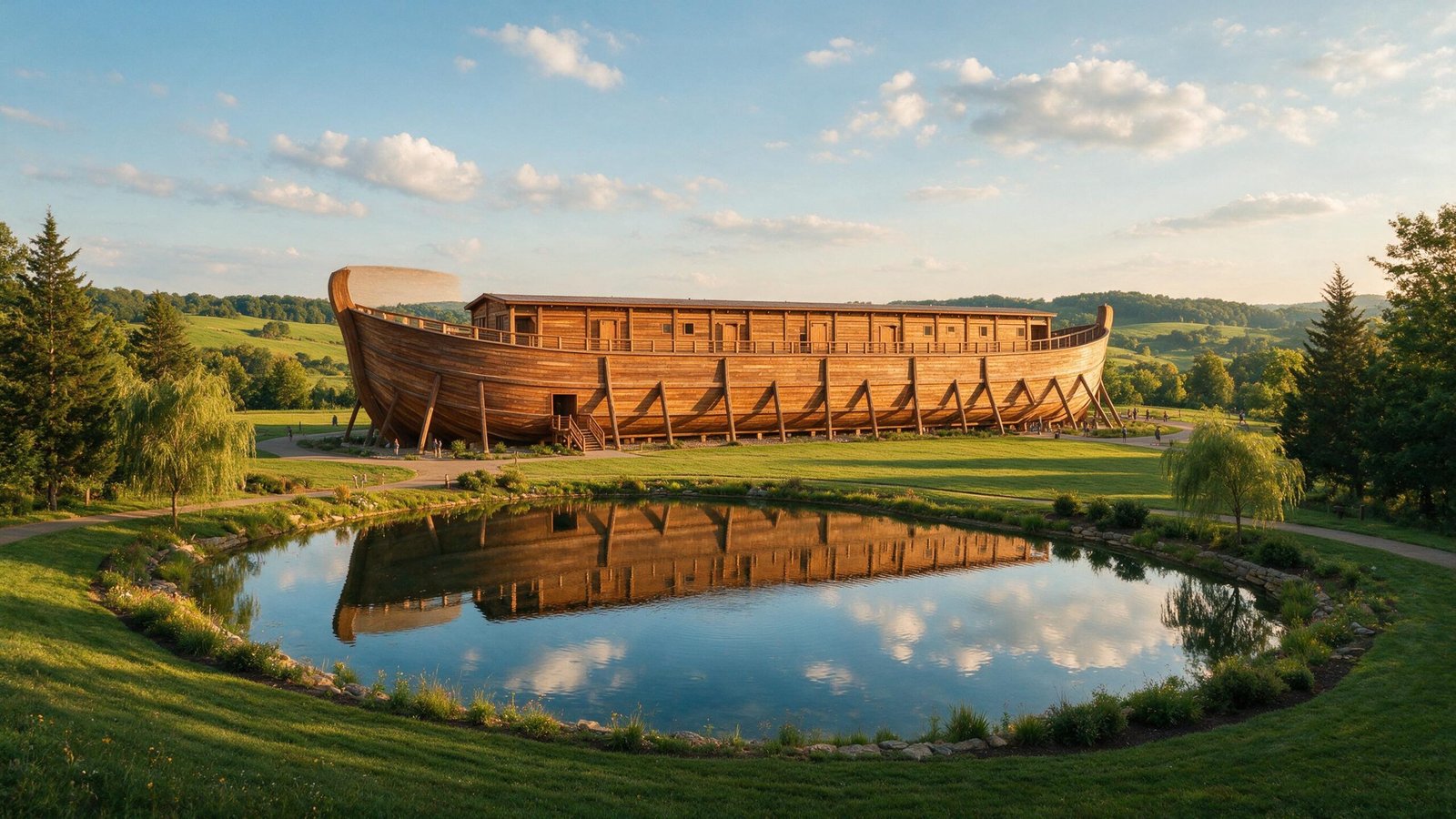
The intersection of religious conviction, grand-scale architecture, and modern tourism has rarely manifested as distinctively as it does in Williamstown, Kentucky. Rising above the rolling landscape of Grant County is the ark encounter, a full-scale representation of the vessel described in the biblical narrative of Noah. Operated by Answers in Genesis, a Young Earth creationist ministry, this massive structure stands not only as an interactive museum but also as a physical manifestation of a specific theological worldview.
Since its public opening in July 2016, the site has drawn millions of international visitors, sparked intense regional economic debates, and established itself as one of the most visible religious tourism destinations in the United States. To understand the ark encounter requires looking beyond its staggering dimensions into the complex engineering, the meticulous design of its interior exhibits, and the broader cultural context that fueled its creation.
Technical Specifications and Corporate Framework
To contextualize the scale and administrative structure of the project, the following data delineates the architectural dimensions and institutional parameters governing the venue.
| Parameter | Specification / Data Points |
| Official Title | Ark Encounter |
| Parent Organization | Answers in Genesis (AiG) |
| Key Leadership | Ken Ham (Founder and Chief Executive Officer) |
| Location | Williamstown, Grant County, Kentucky, USA |
| Inauguration Date | July 7, 2016 |
| Length of Vessel | 510 feet (approx. 155 meters) |
| Width of Vessel | 85 feet (approx. 26 meters) |
| Height of Vessel | 51 feet (approx. 15.5 meters) |
| Primary Material | Responsibly salvaged and harvested timber (Engelman Spruce, Douglas Fir) |
| Structural Typing | Mass timber-frame building with internal steel reinforcement |
Genesis of a Monument: Vision and Development
The conceptual origins of the ark encounter are inextricably linked with Ken Ham, an Australian-born Christian apologist who co-founded Answers in Genesis. Having already established the Creation Museum in Petersburg, Kentucky, in 2007, Ham and his organization sought a grander, more immersive platform to communicate their literal interpretation of the Book of Genesis. The objective was to transition from standard museum exhibits to a monumental experience that could withstand literal comparison to biblical descriptions.
Planning began in earnest during the late 2000s, with the formal announcement of the project occurring in late 2010. The selection of Williamstown, positioned along the busy Interstate 75 corridor, was strategic, offering accessibility to major population centers across the American Midwest and South.
The development phase, however, was marked by complex financial and legal hurdles. Initial funding models relied heavily on private donations, memberships, and a high-profile bond issuance by the city of Williamstown. A central point of public contention emerged regarding the project’s eligibility for the Kentucky Tourism Development Act, which offered substantial sales tax rebates for major tourism attractions.
The state initially approved the incentives but later rescinded them, citing concerns over the religious mission of Answers in Genesis and the implementation of a religious test for the attraction’s employees. Answers in Genesis filed a federal lawsuit claiming a violation of the First Amendment, and in January 2016, a federal judge ruled in the ministry’s favor, restoring the tax incentives and clearing the final administrative path for the grand opening.
Architectural Triumph and Construction Engineering
From an engineering perspective, the ark encounter is a legitimate marvel of modern mass-timber construction. The dimensions of the structure are derived from the biblical measurements of 300 cubits long, 50 cubits wide, and 30 cubits high. To translate the ancient Egyptian or Hebrew cubit into modern units, the design team utilized a standardized calculation of 20.4 inches per cubit, resulting in a building that measures 510 feet in length, 85 feet in width, and 51 feet in height.
The construction required the expertise of both modern structural engineers and traditional craftsmen. A significant portion of the timber framing was executed by Amish carpenters who utilized traditional timber-framing techniques, including mortise-and-tenon joinery secured with wooden pegs. The exterior hull is composed of sustainably sourced Engelmann spruce and Douglas fir, much of it recovered from forests damaged by beetle infestations or fires.
Structural Reinforcement
While the building presents an ancient aesthetic, its structural integrity relies heavily on modern engineering. The ark encounter is classified as a building rather than a boat; it sits permanently on a massive concrete foundation. Internal steel collars, heavy-duty bolts, and concrete cores ensure that the building conforms to modern wind, seismic, and fire safety codes. The interior is divided into three distinct decks, supported by massive columns made from towering logs of Douglas fir, some of which exceed three feet in diameter at their base.
The Interior Experience: Decks, Kinds, and Craftsmanship
The interior of the ark encounter functions as a highly curated, self-guided narrative space. Visitors enter the structure from underneath, ascending through a series of ramps that snake through the three expansive decks. Each deck is designed to address specific aspects of the flood narrative, the mechanics of animal husbandry aboard an ancient vessel, and the theological implications of the biblical text.
Deck One: The Logistics of the Flood
The lowest deck focuses primarily on the immediate environment of the voyage’s commencement. This level features rows of meticulously built wooden cages containing life-sized models of various animal types. In accordance with Young Earth creationist theology, the exhibits do not display every modern animal species; instead, they present the concept of created kinds.
The displays suggest that Noah only needed to house ancestral archetypes from which modern species diversified. Consequently, visitors encounter representations of extinct creatures, including juvenile dinosaurs, alongside familiar mammals and reptiles. The atmosphere on this deck uses ambient soundscapes, replicating the sounds of storm winds, creaking timbers, and distant animal noises to heighten the immersion.
Deck Two: Technology and Technical Viability
The middle deck transitions from animal containment to the practical mechanics of how a small family could sustain thousands of creatures for over a year. This section features detailed dioramas explaining hypothetical ancient technologies used for:
- Waste Management: Sloped cage floors leading to automated waste troughs.
- Ventilation Systems: Central air shafts running through the spine of the ship, powered by the natural rocking of the vessel or convective currents.
- Freshwater Distribution: Interconnected gravity-fed piping networks drawing from massive storage cisterns.
- Food Storage: Specialized rooms dedicated to dried grains, hydroponic fodder, and dried insect cultivation to sustain specific diets.
This deck also houses an extensive workshop exhibit, showcasing the hypothetical tools and construction techniques Noah’s family might have deployed during the century leading up to the deluge.
Deck Three: The Human Element and Modern Ideology
The third and highest deck turns its attention inward, focusing on the lives of the eight individuals who survived the flood: Noah, his wife, their three sons, and their daughters-in-law. Visitors walk through beautifully rendered living quarters, complete with replicated kitchens, textile workshops, and study areas. These spaces are designed to counter the historic portrayal of ancient humans as primitive, instead presenting Noah’s family as highly intelligent, cultured, and technologically capable.
Additionally, Deck Three contains explicit theological commentary. Large-scale graphic displays critique historical skepticism regarding the flood, offer arguments favoring a global rather than localized deluge, and contrast the biblical narrative with other ancient flood epics, such as the Epic of Gilgamesh. The final sections of the deck contain evangelistic presentations detailing the narrative of salvation as understood within mainstream evangelical Christianity.
The Broader Campus: Beyond the Hull
While the timber vessel remains the central anchor of the property, the ark encounter has expanded significantly into a multi-faceted family destination. The surrounding grounds are systematically developed to lengthen visitor stay times and diversify the entertainment offerings.
Ararat Ridge Zoo and Botanical Displays
Located directly adjacent to the vessel is the Ararat Ridge Zoo, an outdoor zoological park that houses an array of live animals, including camels, ostriches, kangaroos, and goats. The zoo integrates educational presentations that reinforce the ministry’s teachings on animal adaptation and post-flood migration. Surrounding the zoo are expansive manicured gardens and walking paths designed to handle high-volume pedestrian traffic.
Emzara’s Restaurant and Dining Operations
To accommodate thousands of daily patrons, the site features extensive culinary infrastructure, headlined by Emzara’s Restaurant. Named after the traditional rabbinic designation for Noah’s wife, this two-story, 1,500-seat buffet building is one of the largest restaurants in the region, serving classic American fare within a timber-heavy architectural environment that complements the main attraction.
Adventure Tourism and Virtual Reality
In an effort to appeal to younger demographics and secular tourists seeking outdoor recreation, the ark encounter incorporates a sprawling zipline network known as the Screaming Eagle Aerial Adventures. This course features miles of high-flying lines and jump towers.
Furthermore, the park features a high-tech virtual reality theater titled the Truth Traveler. This experience utilizes motion-seat technology and VR headsets to take participants on a simulated journey back in time to witness the construction of the ark and the onset of the biblical flood waters.
Socioeconomic Impact and Regional Debates
The presence of the ark encounter in Northern Kentucky has generated considerable academic and economic scrutiny. For Grant County, historically an economically depressed rural region, the arrival of a multi-million-dollar tourism asset brought promises of rapid commercial revitalization.
Local proponents point to the substantial increase in hospitality tax revenues, the construction of new hotels along the highway corridors, and the creation of hundreds of seasonal and permanent jobs within the park. The attraction draws a steady influx of out-of-state buses and family vacationers, providing a reliable economic boost to gas stations, restaurants, and short-term rental properties throughout Williamstown and surrounding municipalities.
Conversely, critics argue that the economic benefits have not distributed as evenly across the local community as initially projected. A point of historical contention involves the infrastructure costs borne by the city, alongside the fact that Answers in Genesis purchased much of the surrounding land, keeping certain secondary developments within their non-profit or tax-advantaged corporate umbrella. Despite these persistent public policy debates, the venue remains a powerful anchor for regional tourism, drawing synergy from its sister property, the Creation Museum, located forty miles to the north.
Cultural Context and Scholarly Reception
The ark encounter exists as a prominent monument within the broader landscape of modern American religious expression and the ongoing cultural discourse surrounding science and faith. Within mainstream secular scientific and academic communities, the exhibits presented inside the structure are viewed through a critical lens.
Geologists, paleontologists, and evolutionary biologists universally reject the scientific premises of Young Earth creationism, pointing out that mainstream consensus establishes the Earth’s age at approximately 4.5 billion years and considers a global cataclysmic flood uncorroborated by the geological record.
For Answers in Genesis and the patrons who frequent the site, however, the ark encounter is not viewed as an exercise in anti-intellectualism, but rather as an alternative educational framework. It serves as a physical defense of biblical inerrancy. By presenting their arguments with high-production museum graphics, interactive media, and sophisticated architectural design, the creators have successfully mimicked the authority of natural history museums, providing their community with a tangible sense of cultural validation and intellectual defense.
Essential Travel Logistics for Potential Visitors
For those planning an excursion to this unique structural landmark, maximizing the value of the experience requires an understanding of basic operational logistics.
Seasonality and Timing
The attraction operates year-round, but the experience varies significantly by season. The summer months (June through August) bring the highest crowds and longest queues, alongside warm, humid Kentucky weather. The autumn season offers milder temperatures and scenic foliage across the Grant County hills. Visitors wishing to experience the park with minimal crowds should target mid-week arrivals during the late winter or early spring months.
Time Investment
Given the sheer scale of the 510-foot vessel and the breadth of the outdoor campus, a thorough exploration cannot be rushed. A comprehensive tour of the three interior decks requires a minimum of three to four hours. When factoring in the Ararat Ridge Zoo, casual dining at Emzara’s, and potential participation in the zipline or virtual reality experiences, visitors are highly encouraged to allocate a full day—approximately six to eight hours—to experience the entire site comfortably.
Frequently Asked Questions
Is the entire structure built out of authentic wood?
The exterior cladding and the primary internal support columns are made from authentic timber, utilizing massive logs of spruce and fir. However, to comply with modern building safety codes and handle heavy tourist traffic, the structure incorporates a hidden concrete foundation, steel joinery collars, and concrete elevator cores for accessibility.
Are real, live animals housed inside the main vessel?
No, the animals displayed within the three decks of the main vessel are highly detailed, life-sized artistic models designed to show how different species might have been caged and maintained. Live animals are housed separately outside the timber ship within the Ararat Ridge Zoo.
Is the site fully accessible to individuals with mobility challenges?
The facility is fully compliant with modern accessibility standards. The interior decks are connected by wide, gently sloped wooden ramps that allow smooth transit for strollers and wheelchairs. Electric convenience vehicles and standard wheelchairs are also available for rent at the main guest services entrance.
How does the attraction differ fundamentally from the nearby Creation Museum?
While both sites are operated by Answers in Genesis and share the same theological worldview, they offer completely different formats. The Creation Museum focuses on a chronological walkthrough of biblical history using standard museum corridors, planetarium shows, and botanical gardens. The other site is centered around the single, monumental physical recreation of the vessel itself, focusing intensely on the logistics, scale, and implications of the flood narrative.
Can visitors purchase dual tickets for both northern Kentucky attractions?
Answers in Genesis offers combined ticketing packages that grant admission to both venues. Because the locations are situated roughly 45 minutes apart by car, these combo tickets are typically structured to allow utilization over multiple days, providing a more relaxed pacing for travelers.
Perspectives on an Epic Reconstruction
The ark encounter remains an architectural feat that commands attention regardless of a visitor’s personal theological or philosophical leanings. For some, it stands as an impressive testament to traditional timber-framing craftsmanship and structural engineering on a scale rarely seen in the twenty-first century. For others, it represents a highly sophisticated manifestation of modern religious apologetics operating within the tourism industry.
By anchoring an ancient narrative into a physical, highly tactile space, the site provides a unique window into how historic texts continue to shape modern landscapes, economies, and cultural conversations. Whether viewed as an educational monument, a theme park, or a massive piece of public art, the colossal wooden silhouette rising above the Kentucky highway stands as a compelling landmark in the geography of contemporary American tourism.
Read more:https://articlebytes.co.uk/chicago-cubs-vs-milwaukee-brewers-match-player-stats/