


How to Convert mg to ml: Complete Liquid Dosage Guide
Converting mass to fluid volume is a fundamental calculation encountered in pharmacy, clinical medicine, analytical chemistry, and culinary arts. The conversion of mg to ml represents a transition between two distinct physical dimensions: mass, measured in milligrams, and volume, measured in milliliters. Because mass measures the amount of matter in a substance while volume measures the space that substance occupies, direct one-to-one conversion is impossible without knowing the specific property that links them: density or concentration.
Understanding how to calculate mg to ml accurately is essential for safe medication administration, accurate chemical compounding, and reliable laboratory experiments. A misstep in converting mg to ml can result in under-dosing or severe toxicity in clinical settings. This comprehensive guide provides a thorough exploration of the physical principles, mathematical formulas, concentration dynamics, and practical steps required to navigate every conversion scenario with complete accuracy.
Fundamental Concepts of Mass and Volume
To successfully perform an mg to ml calculation, one must first recognize the fundamental differences between mass and volume within the metric system.
Mass refers to the quantity of matter present within an object or substance. In the International System of Units (SI), the base unit of mass is the kilogram, with milligrams representing one-millionth of a kilogram, or one-thousandth of a gram. Mass remains constant regardless of environmental conditions such as gravity, pressure, or temperature.
Volume describes the three-dimensional space occupied by a fluid, gas, or solid. The metric system uses the liter as a standard volume unit, with milliliters representing one-thousandth of a liter. Unlike mass, liquid volume can expand or contract slightly depending on temperature and pressure.
Because mass and volume quantify different physical attributes, you cannot convert mg to ml by simply shifting a decimal point unless the substance in question has a known ratio connecting its weight to its space.
The Role of Density and Water as a Baseline
The core physical property connecting mass and volume is density ($\rho$). Density is defined as mass per unit volume, typically expressed in grams per milliliter ($\text{g/mL}$) or kilograms per cubic meter ($\text{kg/m}^3$).
$$\text{Density} = \frac{\text{Mass}}{\text{Volume}}$$
In pure water at maximum density (4°C or 39.2°F), the relationship between mass and volume is perfectly unified:
1 gram of pure water occupies exactly 1 milliliter of space.
Since 1 gram equals 1,000 milligrams, water exhibits a direct relationship where 1,000 milligrams equals 1 milliliter. Therefore, for pure water:
$$\text{Volume (mL)} = \frac{\text{Mass (mg)}}{1000}$$
For water, converting 500 mg to ml yields exactly 0.5 mL. However, most liquids encountered in pharmaceuticals, chemistry, and daily life are not pure water. Liquids such as syrups, oils, alcohol solutions, and suspensions possess densities significantly different from water, meaning a custom mg to ml calculation is necessary for each fluid.
Understanding Concentration in Solutions
In clinical medicine and pharmacology, liquid medications are prepared as solutions or suspensions containing active pharmaceutical ingredients dissolved or dispersed within a liquid vehicle. In these contexts, converting mg to ml relies on liquid concentration rather than pure physical density.
Concentration expresses how much active drug (in milligrams) exists within a given volume of liquid (in milliliters). Pharmaceutical packaging typically displays concentration in formats such as:
- Mass per Volume: $250\text{ mg} / 5\text{ mL}$ or $10\text{ mg/mL}$
- Percentage Concentration: $1\%$ w/v (weight/volume), which corresponds to $10\text{ mg/mL}$
- Ratio Strength: $1:1000$, which corresponds to $1\text{ mg/mL}$
When calculating mg to ml for a liquid drug, the concentration ratio serves as the conversion factor.
Core Formula for Converting Mass to Volume
To convert any dose from mg to ml, use the universal dimensional analysis formula:
$$\text{Volume (mL)} = \frac{\text{Desired Mass (mg)}}{\text{Concentration Strength (mg/mL)}}$$
If the concentration is expressed as a ratio of milligrams per multiple milliliters (e.g., $125\text{ mg per } 5\text{ mL}$), the formula adapts to:
$$\text{Volume (mL)} = \left( \frac{\text{Desired Mass (mg)}}{\text{Available Mass (mg)}} \right) \times \text{Available Volume (mL)}$$
Step-by-Step Calculation Example
Suppose a physician prescribes $375\text{ mg}$ of an oral antibiotic suspension. The medication bottle indicates a concentration of $250\text{ mg per } 5\text{ mL}$.
- Identify Desired Mass: $375\text{ mg}$
- Identify Concentration Unit: $250\text{ mg per } 5\text{ mL}$
- Calculate Unit Concentration: $250 \div 5 = 50\text{ mg/mL}$
- Apply Formula: $375\text{ mg} \div 50\text{ mg/mL} = 7.5\text{ mL}$
The patient requires exactly $7.5\text{ mL}$ of the liquid medication to receive the intended $375\text{ mg}$ dose.
Converting mg to ml for Liquids with Varying Densities
Outside of pharmaceutical solutions where concentration is pre-determined, chemical solutions and pure liquids require direct consideration of specific gravity or fluid density.
$$\text{Volume (mL)} = \frac{\text{Mass (mg)}}{\text{Density (g/mL)} \times 1000}$$
| Fluid Type | Approximate Density (g/mL) | Volume of 1,000 mg (1 g) |
| Pure Water | 1.00 g/mL | 1.00 mL |
| Vegetable Oil | 0.92 g/mL | 1.09 mL |
| Glycerin | 1.26 g/mL | 0.79 mL |
| Ethanol (Pure) | 0.789 g/mL | 1.27 mL |
| Whole Milk | 1.03 g/mL | 0.97 mL |
| Honey | 1.42 g/mL | 0.70 mL |
Because glycerin is denser than water, $1,000\text{ mg}$ of glycerin occupies only $0.79\text{ mL}$. Conversely, because ethanol is less dense than water, $1,000\text{ mg}$ of ethanol occupies $1.27\text{ mL}$. Ignoring density when performing an mg to ml conversion for non-water liquids leads to significant volumetric errors.
Clinical Applications and Patient Safety
Accurate conversion of mg to ml is a cornerstone of safe pediatric and adult healthcare administration. Pediatric dosing, in particular, relies almost exclusively on weight-based calculations converted into precise liquid volumes.
| Medication | Common Strength | Target Dose (mg) | Converted Volume (mL) |
| Acetaminophen Oral Suspension | 160 mg / 5 mL | 160 mg | 5.0 mL |
| Ibuprofen Infant Drops | 50 mg / 1.25 mL | 100 mg | 2.5 mL |
| Amoxicillin Suspension | 400 mg / 5 mL | 200 mg | 2.5 mL |
| Diphenhydramine Elixir | 12.5 mg / 5 mL | 25 mg | 10.0 mL |
| Morphine Oral Solution | 20 mg / 1 mL | 10 mg | 0.5 mL |
When administering oral liquid drugs, healthcare providers recommend calibrated oral syringes or dosing cups marked in milliliters rather than household tableware. Kitchen spoons vary widely in volume (ranging from 3 mL to 7 mL) and should never be used for executing a calculated mg to ml dose.
Reference Overview: Measurement Profile
The following reference profile summarizes the essential units and conversion properties governing mass-to-volume calculations in scientific practice.
| Profile Attribute | Technical Standard & Measurement Details |
| Primary Mass Unit | Milligram (mg) = $10^{-3}$ grams = $10^{-6}$ kilograms |
| Primary Volume Unit | Milliliter (mL) = $10^{-3}$ liters = 1 cubic centimeter ($\text{cm}^3$) |
| Connecting Attribute | Mass Density ($\text{g/mL}$) or Solution Concentration ($\text{mg/mL}$) |
| Standard Baseline | Pure Water at 4°C ($1\text{ mg} = 0.001\text{ mL}$ or $1,000\text{ mg} = 1\text{ mL}$) |
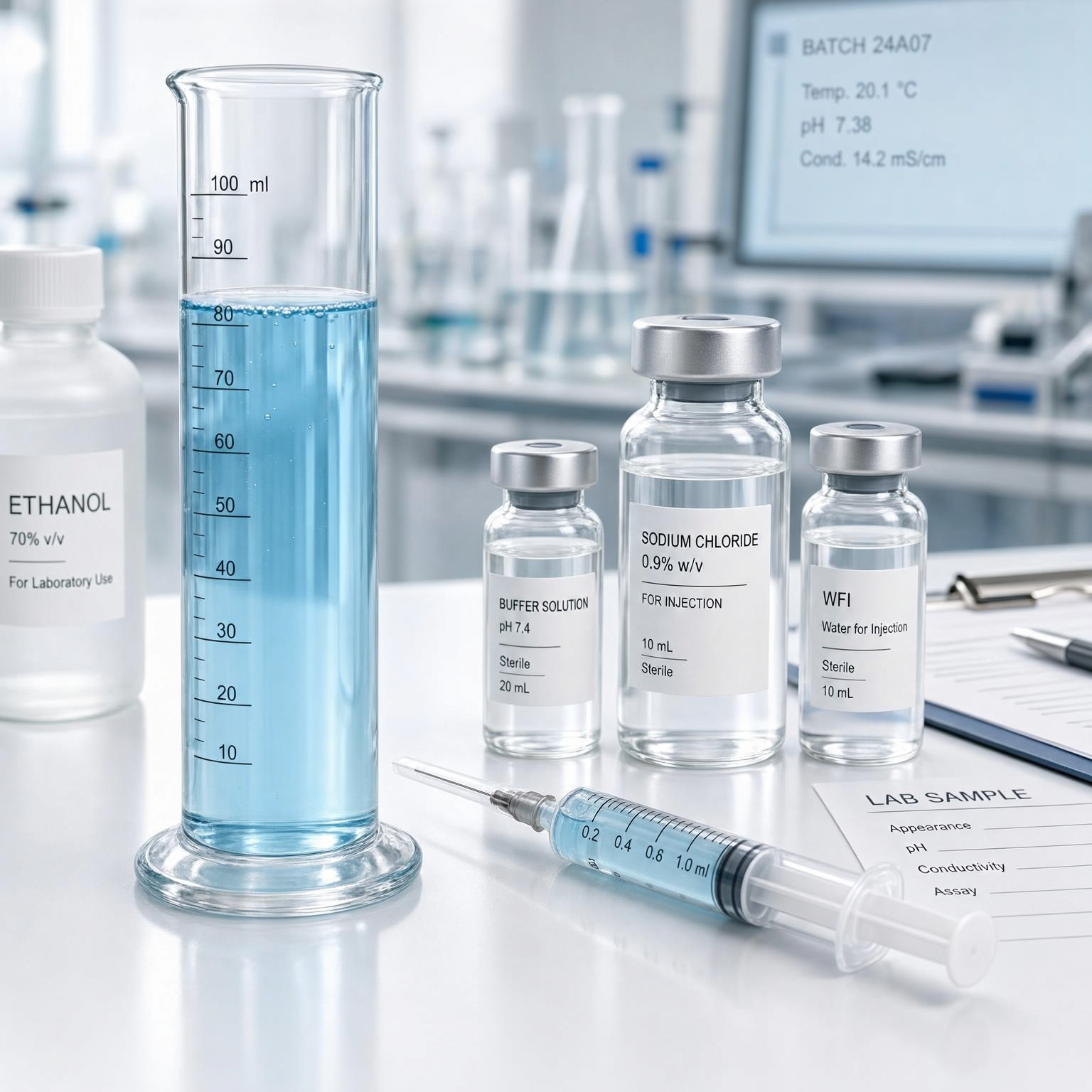
| Primary Measurement Tools | Calibrated syringes, volumetric flasks, micropipettes, graduated cylinders |
| Common Clinical Errors | Confusing mg strength with total volume; using household spoons |
| Source Reference Standard | Metric System (SI), International Pharmacopeia |
Metric Conversions: Mass and Volume Hierarchy
Understanding where milligrams and milliliters sit within the metric system prevents order-of-magnitude errors during conversion.
$$\begin{aligned} 1 \text{ Kilogram (kg)} &= 1,000 \text{ Grams (g)} = 1,000,000 \text{ Milligrams (mg)} \\ 1 \text{ Gram (g)} &= 1,000 \text{ Milligrams (mg)} \\ 1 \text{ Liter (L)} &= 1,000 \text{ Milliliters (mL)} \\ 1 \text{ Milliliter (mL)} &= 1 \text{ Cubic Centimeter (cc)} \end{aligned}$$
When dealing with highly potent medications or micro-chemistry, micrograms ($\mu\text{g}$ or mcg) may be encountered:
$$1 \text{ Milligram (mg)} = 1,000 \text{ Micrograms (mcg)}$$
Converting from micrograms to milliliters requires a two-step approach: convert micrograms to milligrams first, then apply the standard concentration formula to determine the final volume in milliliters.
Special Case: Percentage Strength to mg/mL
Pharmaceutical preparations frequently label strength as a percentage, such as $0.9\%$ Normal Saline or $2\%$ Lidocaine. Converting percentage strength into an active concentration of milligrams per milliliter is a vital skill.
By definition, a percentage weight-in-volume ($\%\text{ w/v}$) represents grams of solute per $100\text{ mL}$ of liquid.
To convert percentage strength directly to $\text{mg/mL}$, multiply the percentage by $10$:
$$\text{Concentration (mg/mL)} = \text{Percentage Strength (\%)} \times 10$$
Practical Examples:
- $0.9\%$ Saline Solution: $0.9 \times 10 = 9\text{ mg/mL}$. Therefore, $1\text{ mL}$ contains $9\text{ mg}$ of sodium chloride.
- $2\%$ Lidocaine Solution: $2 \times 10 = 20\text{ mg/mL}$. A $5\text{ mL}$ vial contains $100\text{ mg}$ of lidocaine ($20\text{ mg/mL} \times 5\text{ mL}$).
- $5\%$ Dextrose Solution: $5 \times 10 = 50\text{ mg/mL}$. A $100\text{ mL}$ bag contains $5,000\text{ mg}$ ($5\text{ grams}$) of dextrose.
Once the $\text{mg/mL}$ concentration is established, any mg to ml request can be solved using standard division.
Avoiding Mistakes in Volume Conversions
Errors in converting mass units to volume units account for a noticeable fraction of medical dosing mistakes. Implementing structured checking procedures virtually eliminates these safety risks.
1. Verification of Active Unit vs. Container Volume
A common oversight occurs when confusing total container volume with concentration strength. For instance, a bottle labeled $500\text{ mg} / 100\text{ mL}$ provides $5\text{ mg/mL}$, whereas a vial labeled $500\text{ mg} / 2\text{ mL}$ provides $250\text{ mg/mL}$. Always divide total milligrams by total milliliters on the label to establish the true single-milliliter strength before calculating a patient dose.
2. Trailing Zeros and Decimal Points
Decimal placement errors can cause ten-fold over-doses or under-doses. Medical writing standards advise against trailing zeros (write $5\text{ mg}$, not $5.0\text{ mg}$) and require leading zeros before decimals (write $0.5\text{ mL}$, not $.5\text{ mL}$). A misplaced decimal during an mg to ml conversion transforms $0.5\text{ mL}$ into $5\text{ mL}$, delivering ten times the intended dose.
3. Account for Reconstitution Displacements
Many antibiotic powders require reconstitution with sterile water prior to administration. The dry powder itself displaces liquid volume. When calculating the final mg to ml concentration of reconstituted drugs, rely on the final yield volume stated on the manufacturer instructions, rather than the volume of water added.
Methodological Comparison of Measurement Systems
| Measurement Attribute | Mass (mg) | Volume (mL) | Concentration (mg/mL) |
| Physical Property | Amount of matter | Space occupied | Ratio of mass to space |
| Measuring Instrument | Analytical balance / scale | Syringe, pipette, cylinder | Derived mathematical value |
| Sensitivity to Temp. | Completely invariant | Expands/contracts slightly | Inversely affected by thermal expansion |
| Primary Application | Active ingredient specification | Liquid administration | Dosing calculations & formulation |
Frequently Asked Questions
Is 1 mg equal to 1 ml?
No, 1 mg does not equal 1 ml. A milligram measures mass, while a milliliter measures volume. For pure water, $1,000\text{ mg}$ equals $1\text{ mL}$. Therefore, $1\text{ mg}$ of pure water equals $0.001\text{ mL}$. For other liquids, the conversion depends entirely on density or concentration.
How do I calculate mg to ml without a concentration listed?
You cannot convert mass to liquid volume without knowing either concentration or density. If the liquid is a pure solvent or oil, look up its physical density ($\text{g/mL}$). If it is a pharmaceutical solution, consult the product monograph or prescription label to find the milligram-per-milliliter ratio.
Why do liquid medicines use milliliters instead of milligrams for dosing?
Milliliters describe fluid volume, which is easily measured using volumetric devices like oral syringes, cups, and droppers. Patients cannot easily weigh liquid doses in milligrams at home, so manufacturers provide concentration guidelines that allow conversion into simple milliliter measurements.
How many ml is 500 mg of liquid paracetamol or acetaminophen?
It depends on the formula concentration. For standard adult liquid acetaminophen ($160\text{ mg per } 5\text{ mL}$), $500\text{ mg}$ requires $15.625\text{ mL}$. For concentrated infant drops ($80\text{ mg per } 0.8\text{ mL}$), $500\text{ mg}$ requires $5\text{ mL}$. Always verify the bottle label.
Does temperature affect the conversion of mass to volume?
Yes, liquid volume expands as temperature rises, which decreases liquid density slightly. While these changes are negligible for ordinary medication dosing at room temperature, high-precision analytical chemistry requires temperature control when converting mass to volume.
Advanced Practical Scenarios
Continuous Infusion Rate Calculations
In clinical critical care, IV medications are delivered using volumetric infusion pumps calibrated in milliliters per hour ($\text{mL/hr}$). Converting a prescribed drug dose (e.g., milligrams per minute) into an pump delivery rate demands precise dimensional conversion.
Scenario: A patient requires a nitroglycerin drip at $20\text{ mcg/min}$. The pharmacy supplies an infusion bag containing $50\text{ mg}$ of nitroglycerin in $250\text{ mL}$ of $D_5W$.
- Convert Bag Concentration to Uniform Units:$$50\text{ mg} = 50,000\text{ mcg}$$$$\text{Concentration} = \frac{50,000\text{ mcg}}{250\text{ mL}} = 200\text{ mcg/mL}$$
- Determine Hourly Microgram Requirement:$$20\text{ mcg/min} \times 60\text{ minutes/hour} = 1,200\text{ mcg/hour}$$
- Convert Required Mass to Volume Rate:$$\text{Pump Rate} = \frac{1,200\text{ mcg/hour}}{200\text{ mcg/mL}} = 6\text{ mL/hour}$$
By converting mass rates to volumetric rates step by step, complex clinical infusions become straightforward operational pump settings.
Compounding Syrups and Viscous Solutions
When formulating dense pharmaceutical syrups, thick vehicles such as Simple Syrup NF (density $\approx 1.31\text{ g/mL}$) shift fluid dynamics. If a compounder attempts to calculate liquid volume assuming water density, significant volumetric errors occur.
For example, measuring $131\text{ grams}$ ($131,000\text{ mg}$) of Simple SyrupNF yields exactly $100\text{ mL}$ of volume, whereas $131\text{ grams}$ of water yields $131\text{ mL}$. Always incorporate specific gravity factors when compounding high-viscosity or non-aqueous formulations.
Master Calculation Framework
To convert mg to ml accurately across any domain, follow this standardized analytical workflow:
[Target Dose in mg] ÷ [Concentration Strength in mg/mL] = [Target Volume in mL]
- Verify the target mass: Express the desired amount strictly in milligrams (mg). Convert grams or micrograms to milligrams first.
- Determine true unit concentration: Express active drug strength strictly as milligrams per single milliliter ($\text{mg/mL}$).
- Divide mass by concentration: Perform division to find the exact liquid volume in milliliters (mL).
- Select appropriate dosing apparatus: Use calibrated syringes or volumetric glassware matched to the final volume scale.
Mastering this core relationship unlocks complete accuracy across pharmaceutical dosing, chemical preparation, and scientific measurement.